Introducing Ora Nanolite: Two Experiments in Useful Small Models

Travis Chauvin
Co-Founder & Head of AI Systems
Most everyday AI work does not require a frontier model with enormous compute, long deliberation, and a remote API call.
A team may need to rewrite an email, summarize a document, draft social copy in a familiar tone, extract information from a form, classify a request, or work through a straightforward calculation. Those are useful jobs, but they are not all the same job as frontier coding, deep research, or open-ended scientific reasoning.
Ora Nanolite is our experimental work on that distinction.
We are introducing two small local Task Models:
- Ora Nanolite: an experimental Qwen3-0.6B model for highly constrained and lightweight everyday tasks.
- Ora Nanolite V2: an experimental Qwen3.5-4B model for more capable local reasoning, structured work, and faster responses.
Neither model is a claim that small models replace frontier AI everywhere. The point is more practical: a model can be made much more useful when it is sized, trained, and evaluated around the work it is actually expected to do.
1. The question
Small models have an obvious advantage: they can run with less memory, less power, lower cost, and lower latency.
Their weakness is equally obvious. A smaller model has less capacity for difficult multi-step reasoning, broad world knowledge, complex coding, long-context synthesis, and ambiguous research.
Our question was not, “Can a small model become a frontier model?”
It was:
Can we create smaller local models that complete useful work quickly, reliably, and with an honest understanding of their limits?
We ran two experiments at different capability levels.
2. Ora Nanolite: a 0.6B model for lightweight local work
The first Ora Nanolite experiment used a Qwen3-0.6B base model. At this size, the priority is not broad intelligence. It is speed, low resource use, and dependable performance on narrow everyday tasks.
We trained and evaluated it around concise workplace-style work: drafting, rewriting, simple calculations, structured responses, and other routine tasks where a long internal monologue is often unnecessary.
Experimental result
Across 40 internal reasoning-enabled workplace prompts:
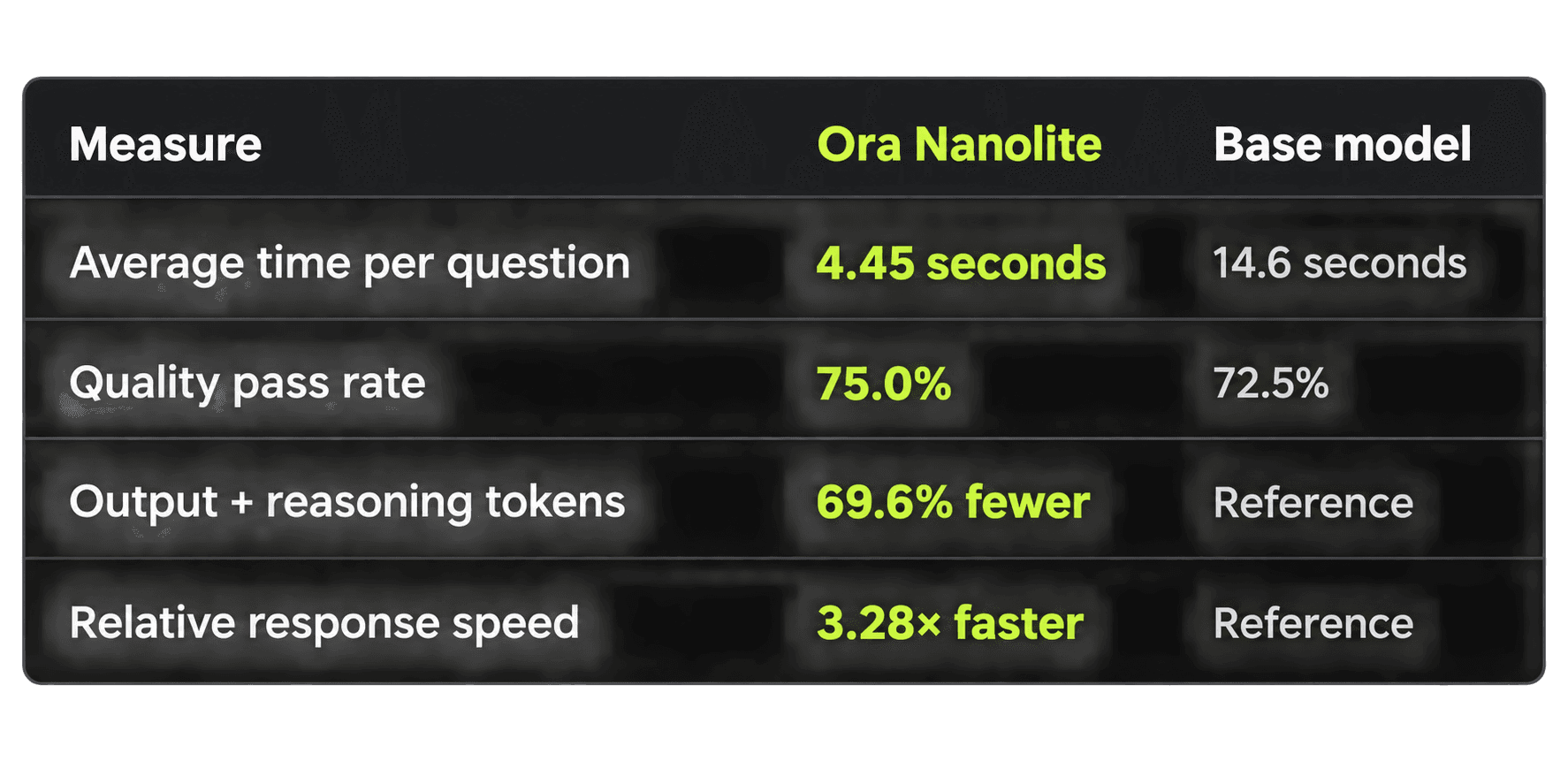
This is a small internal experiment, not a general benchmark claim. The sample is useful for understanding the model’s intended behavior, but it is not large enough to establish broad capability.
What Ora Nanolite is for
Ora Nanolite is best suited to lightweight, repetitive, private tasks where speed matters more than deep reasoning:
Drafting emails and replies
Rewriting text in a defined tone
Social posts and short workplace copy
Template-based customer responses
Simple calculations and conversions
Extracting fields from structured text
Basic classification and routing
Brief summaries of supplied content
Straightforward question answering over retrieved context
It is especially interesting for constrained hardware, edge devices, and local workflows where a larger model would be unnecessary or too expensive to run continuously.
What Ora Nanolite is not for
A 0.6B model should not be positioned as a replacement for frontier reasoning.
It is not the right choice for:
Complex coding or agentic software engineering
Difficult multi-step research
High-stakes legal, financial, or medical judgment
Autonomous fact-finding without trusted context
Long, ambiguous planning tasks
Difficult symbolic reasoning
Decisions where an error has material consequences
Nanolite is intended to be a fast local worker for small jobs, not a general intelligence in miniature.
3. Ora Nanolite V2: a more capable 4B reasoning model
Ora Nanolite V2 explores a different question.
Instead of making the model extremely small, we started with a Qwen3.5-4B base model and trained it to produce cleaner, more direct reasoning. The objective was not to reduce its parameter count. The objective was to reduce unnecessary output and reasoning tokens while preserving useful performance.
The result is a 4B Task Model that is substantially more capable than the 0.6B model, while still behaving far more efficiently than its base checkpoint on reasoning-enabled tasks.
How we evaluated V2
We tested the original Qwen3.5-4B base model and the enhanced Nanolite V2 checkpoint on a 500-question benchmark plan:
125 GSM8K mathematics questions
285 MMLU-Redux multiple-choice questions
90 BBH reasoning questions
GSM8K and BBH were run with reasoning enabled. MMLU-Redux was run as a short-answer multiple-choice task without reasoning enabled.
The two checkpoints were run independently on matched GPU environments. Because the original model exceeded the token budget on many reasoning prompts, we also performed a stricter paired analysis: only prompts completed validly by both models were compared.
What changed
On matched GSM8K and BBH prompts, Nanolite V2 generated approximately 92% fewer output and reasoning tokens.
On BBH, the enhanced model was up to 15.3× faster on the mutually completed prompts. On GSM8K, it was approximately 14.4× faster.
This is not a claim that each token became 15× faster to compute. The main reason for the speedup is simpler: Nanolite V2 stops producing unnecessary self-talk, repeated planning, formatting checks, and redundant reconsideration.
The base model frequently generated long passages such as:
Restating the task
Planning its answer structure
Repeating a solved calculation
Rechecking formatting requirements
Running a second “mental simulation”
Revisiting an answer it had already reached
Nanolite V2 generally produced a shorter chain: identify the relevant facts, perform the necessary steps, and answer.
Paired capability results
The most honest comparison is the paired subset of 395 prompts where both models completed validly.
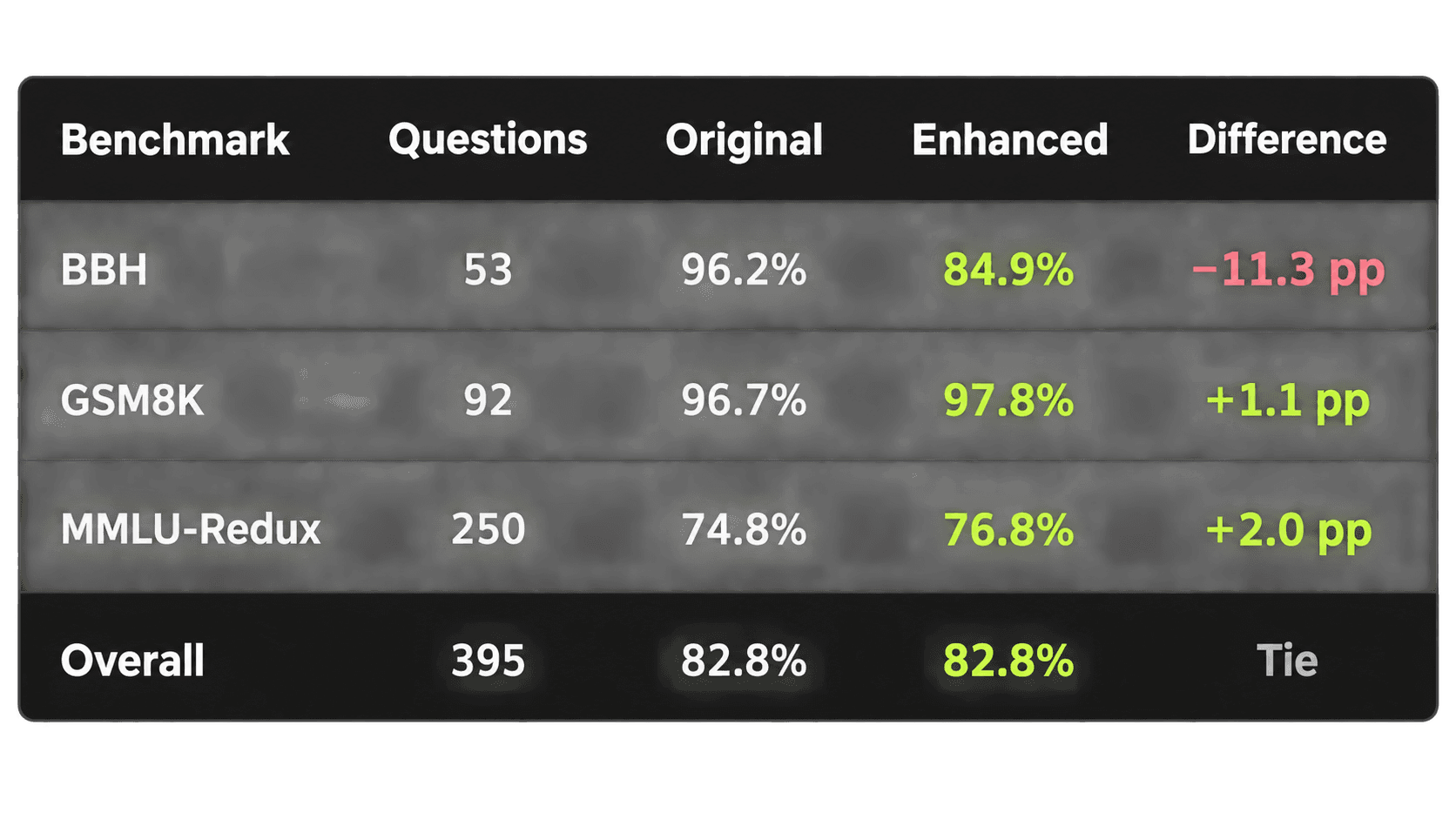
The benchmark initially undercounted several correct Nanolite V2 BBH answers because it rejected responses such as (C) Sam when the expected format was only (C). We manually audited the disagreements and corrected those parsing errors before reporting the table above.
The conclusion is nuanced:
Nanolite V2 preserved overall paired accuracy.
It improved slightly on GSM8K and MMLU-Redux, but not enough to conclude a genuine improvement in reasoning capabilities.
It was dramatically faster on reasoning-enabled prompts.
It regressed on a subset of BBH tasks involving symbolic state tracking, Boolean precedence, date interpretation, formal logic, and sequential swaps.
That last point matters. Faster, shorter reasoning is useful only when it does not omit a necessary step.
4. What Nanolite V2 is for
Nanolite V2 is not a frontier research or coding model. It is a more capable local Task Model for work that benefits from structured reasoning but does not require the full cost of a frontier system.
Good use cases include:
More capable workplace writing and editing
Structured document analysis with supplied context
Math, calculations, and explanation
Local knowledge-work assistants
Summarizing and comparing provided materials
Extracting decisions, actions, risks, and key facts from documents
Drafting plans, checklists, briefs, and structured reports
Customer-support assistance with approved knowledge
Private personal or team workflows on capable local hardware
Retrieval-augmented question answering when the necessary documents are supplied
Nanolite V2 is a better fit than the 0.6B model when the task needs several connected steps, stronger language quality, or more reliable interpretation of supplied information.
It is still not the right tool for:
Frontier-level software engineering
Deep autonomous research
High-stakes expert decisions
Complex symbolic puzzles without validation
Large-scale multi-agent work
Unverified factual claims about the current world
Long-horizon planning that depends on uncertain external information
For those jobs, a larger model, retrieval tools, verification steps, or human review remain necessary.
5. A useful model is not always the largest model
The two Nanolite experiments point to the same idea at different scales.
The 0.6B model shows that a very small local model can be useful when the task is narrow, routine, and latency-sensitive.
The 4B model shows that a more capable model can be trained to spend far less time on redundant reasoning while retaining comparable performance on many completed tasks.
This is not a universal recipe. The V2 BBH regressions show that shortening reasoning can harm tasks that depend on careful state tracking. We do not want to train every model to be terse. We want each model to use the amount of reasoning its task actually requires.
That is the direction behind Ora Task Models:
Give the right local model a defined job, a measured capability boundary, and a performance profile that makes sense for the hardware running it.
Experimental notes
Ora Nanolite results are based on 40 internal reasoning-enabled workplace prompts.
Ora Nanolite V2 results are based on a 500-question evaluation plan spanning GSM8K, MMLU-Redux, and BBH.
The paired V2 comparison includes 395 prompts that both checkpoints completed validly.
The original model exceeded the configured token budget on a substantial number of reasoning-enabled prompts; this is why paired results are reported separately from fixed-budget completion behavior.
These are experimental research results, not guarantees of performance on every prompt, hardware configuration, or production workflow.
Capable AI belongs on your hardware.
Ora is building local model packs, runtimes, and Task Models for people and teams who want useful AI without treating every task like a cloud-scale problem.
About the author
Travis Chauvin
Co-Founder & Head of AI Systems
Travis Chauvin is a Co-Founder and Head of AI Systems at Ora Frontier, where he is building the direction of AI research, focusing on making powerful local AI and personalized intelligence more accessible through consumer-grade hardware.